E-ISSN : XXXX-XXXX
∴ MAIN MENU ∴
∴ SUBMISSION ∴
∴ JOURNAL TEMPLATE ∴
 |
 |
∴ INFORMATION ∴
∴ ISSN BARCODE ∴
 |
∴ INDEXING ∴
 |
 |
 |
 |
∴ TOOLS ∴
 |
 |
 |
 |
∴ STATISTIC ∴
∴ MEMBER ∴
 |
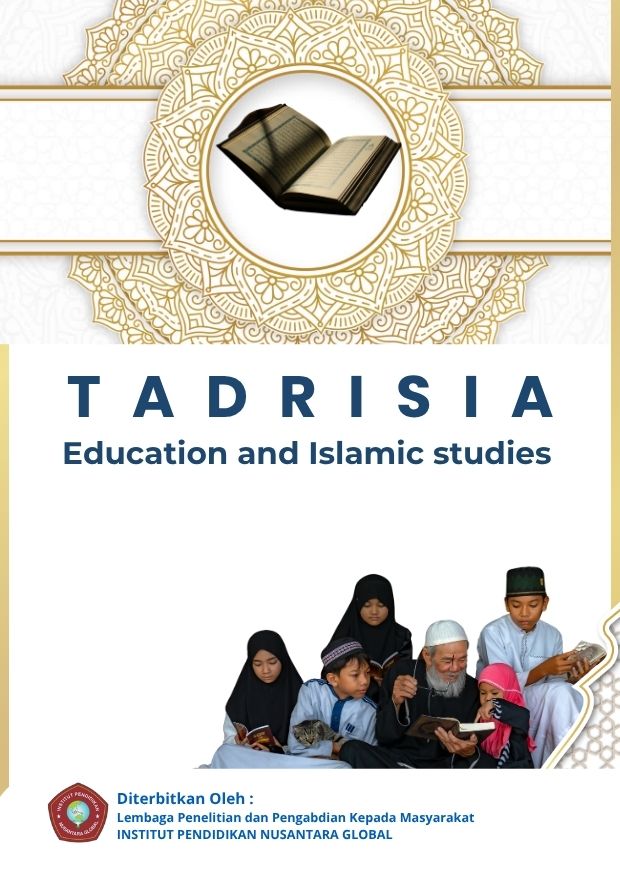
Tadrisia: Education and Islamic Studies
Frequency: 4 issues per year
 |
Journal title | : | Tadrisia: Education and Islamic Studies | |
| Initials | : | Tadrisia | ||
| Website | : | https://research.nusantaraglobal.ac.id/index.php/tadrisia/index | ||
| Frequency | : | 4 issues per year (March, June, September, December) | ||
| DOI | : | https://doi.org/10.55681/tadrisia by Crossref | ||
| Online ISSN | : | xxxx-xxxx | ||
| Editor-in-Chief | : | Arif Al Anang, Lc, M.A [Scopus Id=60617325600] [SINTA ID : 6777693 | ||
| Publisher | : | LPPM Institut Pendidikan Nusantara Global | ||
| Citation Analysis | : | [Sinta] [Google Scholar] |
Tadrisia: Education and Islamic Studies is an international, peer-reviewed, and open-access academic journal dedicated to the scholarly exploration, integration, and dissemination of research at the intersection of modern educational sciences and Islamic studies. The journal provides a rigorous and dynamic forum for educators, theologians, researchers, and social scientists to publish original research, systematic reviews, and empirical studies that address contemporary challenges, innovative methodologies, and structural developments in Islamic Studies and broader educational paradigms within Muslim societies worldwide.
Focus and Scope Tadrisia: Education and Islamic Studies focuses on publishing scholarly works that contribute to the advancement of education and Islamic studies through practical, impactful, and sustainable research and initiatives. It emphasizes pedagogical innovation, problem-solving approaches in contemporary Islamic education, and measurable outcomes that provide meaningful benefits to the academic community and society at large.
The scope of the journal includes, but is not limited to:
Islamic Education and Pedagogy: Innovative teaching methods, learning strategies, and instructional designs within Islamic educational contexts.
Educational Empowerment & Capacity Building: Strengthening the competencies and professional development of educators, students, and educational stakeholders.
Curriculum Development & Program Innovation: The design, implementation, and evaluation of progressive curricula in Madrasahs, Pesantrens (Islamic Boarding Schools), and Islamic Higher Education.
Problem-Solving in Contemporary Islamic Education: Addressing modern challenges in character education, ethics, and the integration of technology in Islamic learning.
Integration of Islamic Studies and Sciences: Interdisciplinary approaches that connect Islamic studies (Al-Qur'an, Hadith, Fiqh, Islamic History) with general and social sciences.
Impact Evaluation of Educational Programs: Assessing the effectiveness, sustainability, and societal impact of educational policies, community-based educational initiatives, and institutional programs.
Publication Frequency and Access Tadrisia is published Quarterly (Four times a year). The journal strictly operates under an Open Access policy, ensuring that fundamental and applied knowledge bridging education and Islamic studies is universally available. All published articles are immediately, permanently, and freely accessible for the worldwide academic, educational, and public community to read, download, copy, and distribute under a Creative Commons (CC) license, eliminating any subscription or paywall barriers.
Peer Review Process To guarantee the highest level of scholarly rigor and academic integrity, every submitted manuscript undergoes a strict double-blind peer review process. Independent expert reviewers from global educational and Islamic studies networks evaluate submissions based on their conceptual originality, methodological soundness, depth of analysis, and practical contribution to serve as a premier, globally accessible nexus for the advancement of educational sciences and to foster a rigorous, transdisciplinary intellectual space where classical Islamic epistemology and contemporary academic disciplines converge. The identities of both the authors and the reviewers remain strictly confidential throughout the evaluation process to ensure absolute objectivity.
Mission Statement: "The mission of Tadrisia is to bridge the gap between researchers, educators, and policymakers to solve the most pressing challenges in modern education, from early childhood development to lifelong learning in the digital age and to elevate Islamic Studies from purely textual analyses to highly relevant, applied sciences that interact with modern economics, sociology, politics, and technology. By fostering a progressive, inclusive, and multi-perspective academic dialogue, the journal aims to inspire enlightened educational reforms, cultivate holistic and morally sound human resource development, and contribute actively to the creation of a resilient and balanced global knowledge ecosystem."
E-ISSN : XXXX-XXXX
∴ MAIN MENU ∴
∴ SUBMISSION ∴
∴ JOURNAL TEMPLATE ∴
|
|
∴ INFORMATION ∴
∴ ISSN BARCODE ∴
|
∴ INDEXING ∴
|
|
|
|
∴ TOOLS ∴
|
|
|
|
∴ STATISTIC ∴
∴ MEMBER ∴
|
Tadrisia: Education and Islamic Studies
Frequency: 4 issues per year